

What is an O&M manual?
An Operation and Maintenance (O&M) manual is the record a facilities team uses to operate and look after a building once the contractor has left. It explains how each system works, what maintenance it needs and how often, which products were installed, who supplied them and what warranties apply.
You will see it called an O&M manual, an OMM, an O&MM or simply "the manuals". On Defence projects the term is OMM and the structure is set by Defence templates. On commercial, health and education projects the client usually publishes its own standard, and the contract makes the manual a condition of practical completion.
The O&M manual is not the same as the building handover manual. The handover manual is the full package given to the owner at completion. The O&M manual is the technical core of that package. Our building handover manual guide covers the wider set.
What goes in an O&M manual
Structures vary by client, but a well-organised manual covers the same ground. The eight-section layout below is the one used in the Defence OMM templates and works for most commercial projects too.
| Section | What it contains |
|---|---|
| 1. Operation description | How each system is meant to work, design intent, normal operating modes and controls |
| 2. Contact directory | Contractor, subcontractors, suppliers and service providers, with phone and email for each |
| 3. Equipment and systems list | Every maintainable asset: make, model, serial number, location, supplier |
| 4. Maintenance procedures | Tasks, frequencies and WHS requirements for each system |
| 5. Manufacturer literature | Product data sheets, installation and operating instructions |
| 6. Warranty information | Warranty terms, start and expiry dates, conditions and claim contacts |
| 7. Critical spare parts | Spares held on site and recommended spares, with part numbers |
| 8. As-constructed drawings | Final drawings showing what was actually built |
On top of that core, most contracts also ask for commissioning and test records, certificates of compliance, the asset register in a format the client's maintenance system can import, and a revision history.
Who supplies each part
The head contractor carries the obligation to deliver the manual, but almost none of the content comes from them. It comes from the trades:
- Mechanical: HVAC equipment schedules, controls descriptions, commissioning and balancing reports, filter and belt schedules.
- Electrical: switchboard schedules, lighting control, emergency lighting test records, single-line diagrams.
- Hydraulic: pumps, hot water plant, backflow device test certificates, valve schedules.
- Fire: system descriptions, AS 1851 maintenance schedules, certification and test records.
- Lifts, security, BMS, façade, roofing: product data, warranties and maintenance requirements for each.
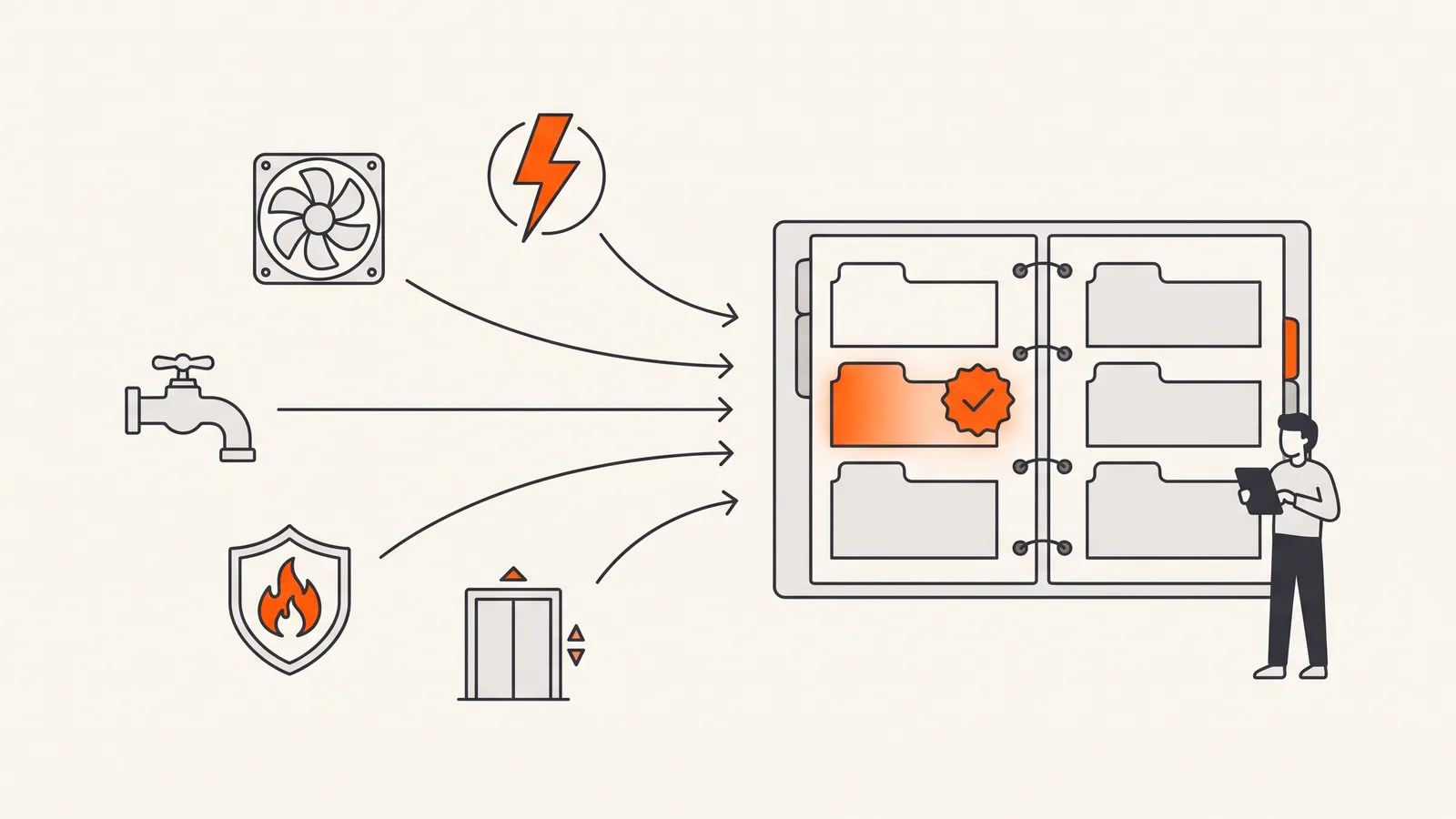
The compiler's job is to collect all of that, check it against the client's standard, chase what is missing and put it into one consistent structure. On a mid-size commercial job that can mean 30 or more subcontractors and several thousand files.
Why O&M manuals get rejected
Manuals are usually rejected for a short list of reasons:
- Generic product data: a full manufacturer catalogue instead of the data sheet for the model actually installed.
- Missing equipment details: no serial numbers or locations, so the asset list cannot be loaded into the client's maintenance system.
- Warranty dates left blank: warranties with no start date, or a start date that does not match practical completion.
- Drawings that are not as-constructed: design or tender drawings submitted in place of final drawings.
- Wrong structure: sections out of order or named differently from the client's standard, so the reviewer cannot find anything.
- Late delivery: the manual is put together in the last fortnight before practical completion, and gaps are only found during the client's review.
Each rejection costs time at the worst point in the job. Practical completion can be held up, and with it the release of security and the final payment claim.
Paper, PDF or digital?
A few clients still ask for printed binders. Most now want a bookmarked PDF, and a growing number want structured data that can be loaded straight into their maintenance or asset management system.
The practical approach is to build the manual once as structured content and export it in whatever format the contract asks for. A single source means a corrected warranty date or a replaced data sheet flows into every output, instead of being fixed in one PDF and forgotten in another.
Defence adds a size constraint: submissions over a set limit have to be split into volumes, each with its own contents page and revision history. Procom does this automatically, as described on the OMM volume splitting page.
How to build an O&M manual without the last-minute scramble
- Agree the structure at subcontract award. Put the client's O&M standard, or the template you will use, into every subcontract so trades know what they owe.
- Assign sections to trades. Each subcontractor should know exactly which sections are theirs.
- Collect as you build. Product data at procurement, warranties at installation, commissioning records at commissioning. Do not wait for completion.
- Review progressively. Check sections as they come in, so problems are fixed while the subcontractor is still on site.
- Track what is missing. Know at any point which sections are complete, under review or empty.
- Export and submit early. Give the client time to review before practical completion, not after it.
The same records carry on into the Defects Liability Period. Warranty information supports defect claims, and the equipment list becomes the owner's asset register.
How Procom handles O&M manuals
Procom is built around producing the O&M manual. Projects start from the OMM Buildings or OMM Base Infrastructure (V2.0) templates, or a custom structure set up for the client's standard. Each subcontractor uploads into their assigned sections through their own portal, and uploads are virus-scanned, validated and version-controlled. The head contractor reviews and approves each section through a configurable workflow, and the finished manual exports to PDF, DOCX, HTML or XLS. See digital O&M manuals for the full feature set.
Frequently asked questions
What does O&M stand for in construction?
O&M stands for Operation and Maintenance. An O&M manual (or OMM) is the handover document that explains how a building's systems work, how they must be maintained and what was installed, by whom and under what warranty.
What is the difference between an O&M manual and a building handover manual?
The O&M manual is the technical core: equipment, maintenance procedures, manufacturer literature, warranties, spares and drawings. A building handover manual is the wider package, which usually includes the O&M manual plus certificates, compliance documents, keys and access records and the building user guide.
Who is responsible for writing the O&M manual?
The head contractor is responsible for delivering it to the client. In practice each subcontractor supplies the content for their own systems (mechanical, electrical, hydraulic, fire and so on), and the head contractor or a documentation specialist compiles, checks and formats it.
When should O&M manual preparation start?
At subcontract award, not at practical completion. Setting the manual structure early and collecting product data, warranties and commissioning records as they are produced is the main thing that stops handover being delayed by documentation.
Is there an O&M manual template?
Many clients publish their own standard, and Defence uses the OMM Buildings and OMM Base Infrastructure templates. A common structure has eight sections: operation description, contact directory, equipment and systems list, maintenance procedures, manufacturer literature, warranties, critical spares and as-constructed drawings.